Former Refugees Have a Dream: A Kibbutz in South Sudan
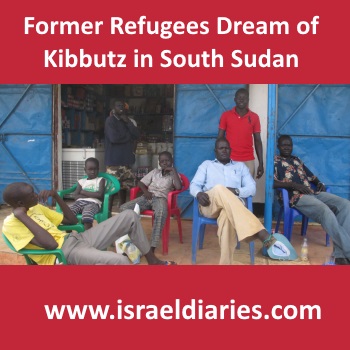
Three former refugees who sheltered in Israel returned home with mixed feelings, gratitude, new knowhow - and drive to transform not only their own lives, but their fledgling country.
This article was originally published in Haaretz - August 2013.
Juba, the capital of South Sudan, is a frenzy of activity. New buildings are rising everywhere you look. Cars travel helter-skelter over the mostly dirt roadways, their drivers having been urged to keep to the right of the road and avoid hitting children or goats. Given the difficulties in supporting their families in rural areas, people come in from the villages seeking work just as they do the world over, and so the slums grow. Here and there, people doing well are replacing their mud-and-thatch-roofed homes with houses of brick and mortar, some with rudimentary plumbing and a generator to provide electricity for at least part of the day. And some are rebuilding their lives with the help of lessons learned in Israel.
[embed]https://www.flickr.com/photos/69986847@N02/32758538838/in/dateposted-public/[/embed]
To visit Majur Gop, Augustino Mayom Makuok and Peter Mading Jok, you begin at the entrance to Jebel Market, the largest market in Juba, covering an area the size of a few Manhattan blocks. People sell everything from colorful African fabrics to handmade kitchen utensils fashioned from what might be considered a form of “up-cycled” throwaways. Hopping on a “boda boda” (motorcycle), you pass by the market, then veer off to the right and find yourself on a dirt road that looks like it is going nowhere.
Suddenly, a small street appears: At the corner is a cement building with large blue doors – their store.
[embed]https://www.flickr.com/photos/69986847@N02/39667952723/in/dateposted-public/[/embed]
They come out with smiles, happy to speak Hebrew once more and with good memories from Israel: the Holy Land, the land of Jesus.
In fact, South Sudan has a special relationship with Israel, which is unique among the nations of the world in supporting them during five decades of war, for example with medicine, food and arms, before the country was formally recognized two years ago.
The three business partners tell similar stories of leaving the embattled south, where civil war raged, for Khartoum, then heading for Cairo to escape the discrimination and violence - only to face discrimination and violence in Egypt as well. From there, many made their way across the Sinai and entered Israel at Eilat.
Majur, 35, worked in Eilat for a time but ended up in Haifa. Augustino, 29, worked at Kibbutz Yotvata in southern Israel, and Jok, the oldest of the three at about 50, stayed in Arad.
[embed]https://www.flickr.com/photos/69986847@N02/39667952643/in/dateposted-public/[/embed]
Majur wanted to study. He had completed his interrupted high school education in Khartoum at the age of 20 and dreamed of going to university. That university degree never came to pass but he did earn enough at his restaurant job in Haifa to take courses in English.
“Before I arrived in Israel, I was young and angry,” Majur says, “but in Israel there were people who cared about me and wouldn’t hurt me.” In Israel, he says, he learned how to work and save for the future.
That doesn't mean the men had idyllic stays in Israel. After an initial, difficult experience on a moshav, where he was treated like a migrant worker rather than the refugee he was, Augustino reached Kibbutz Yotvata, thanks to Tel Aviv’s Hotline for Migrant Workers NGO. He remained there for seven years, until his return home. He credits Israel with teaching him how to "work independently" in agriculture and to plan for the future.
“On the kibbutz,” Augustino remembers, “they pointed at some trees and told me they were planted in 1927. So now I look at South Sudan today and I have a vision of what it will be like 30 years from now.”
Discussion (0)
No comments yet. Be the first to share your thoughts!
You must be logged in to join the discussion.
Log in here or create an account.