Sweden
While Sweden, for example, did not impose a national lockdown on its population, an article in Science Magazine from 6 Oct 2020 stated that:The country did not ignore the threat entirely. Although stores and restaurants remained open, many Swedes stayed home, at rates similar to their European neighbors, surveys and mobile phone data suggest. And the government did take some strict measures in late March, including bans on gatherings of more than 50 people and on nursing home visits.Nursing homes re-opened for visitors only on October 1. That seems like a vote of confidence in the Swedish control over COVID-19. However, even the architect of Sweden's lax regulations approach, state epidemiologist Anders Tegnell, has admitted that the price of 10% excess deaths so far has been too high a price to pay and perhaps Sweden should had a stricter regimen for slowing the pace of infection from the start. A growing increase in positive tests and in the number of seriously ill since September raises the possibility that Sweden cannot avoid a second surge of infections as they hoped; new restrictions are being considered. One would expect that the national economy of a country that kept everything open would not suffer. However, according to Finish economist Lasse Corin:
...consumption decreased... This probably tells us that the virus situation affects consumer behaviour more than the restrictions set by the authorities. People are afraid of the coronavirus whether they can go to their local café and buy their morning latte or not.And this raises the issue of why the Swedish approach may not work in many other countries where the citizens are asking their leaders to emulate this example. Australian expats living in Sweden are sure that Australia could not just issue recommendations as Sweden has, or just ask the people to work from home or maintain social distancing because the Australians would simply not comply. Many writers point to the fact that the Swedes trust their government and if their government asks them to do something, they do so willingly. That certainly would not work in Israel, where there has not been trust in the government (and rightly so, IMO) for decades and where government recommendations are seen as being for everyone else and not for oneself. Other problems in Sweden were brought into focus by the pandemic situation. For example, most homes for the elderly are run as private enterprises and guided by the profit motive rather than best care motive, meaning the residents were not really protected from the virus. In addition, hospital resources were lagging far behind need for years and there were insufficient intense care facilities. Interestingly, dissent from majority views were not allowed: disagreement to Tegell's approach was met with strong backlash to the point that a number of academics left Sweden and others say they will follow. Amazingly, medical professionals wearing masks were frowned upon and one even says his contract was not renewed because he walked around the clinic in a mask. In spite of not having locked down, the GDP of Sweden has suffered and unemployment is high. According to the National Institute of Economic Research,
Sweden's GDP at market price is expected to shrink by 3.4 percent in 2020 ... It will take time before we are back to normal levels. The slump won't be over until 2023.Former Chief Epidemiologist, Annike Linde originally supported Tegnell's approach. But recently she told The Guardian that:
I do not understand how they can stand and say the level of preparedness was good, when in fact it was lousy. ... [one] key mistake was to assume that the coronavirus would behave like seasonal flu. “It does not behave like the flu at all,” she said.Since localized spikes in infection are being recorded around the country, mostly on university campuses, the new policy is one of localized lockdowns.
South Korea
At its worst, South Korea was registering about 800 new cases per day. That was in March. This dropped to fewer than 100 new cases a day one month later. They were able to remain in the double digits aside from a temporary upsurge in August during which there were about 100-200 new cases daily. These are figures Israel can only dream about. The question is: how were they able to do this? Newspapers such as the Wall Street Journal refer to the experience gained from having had to cope with previous epidemics, such as SARS and MERS. Within two days of the government realizing they had another viral epidemic to battle, drive-through testing stations were set up to boost the testing capacity. With insufficient hospital beds to handle the sick, Samsung volunteered unused space to be converted for treating mild cases, leaving the hospitals to tend to the seriously ill. Soon other companies volunteered space in communities around the country and this became the backbone for quaranteeing and treating all those testing positive from the asymptomatic to the mildly ill. These two responses to the virus are impressive, but if you really want to understand what makes South Korea stand out, you just have to go to their Center for Disease Control website. The amount of information there is envious if you are from a country that does not do this. Daily updates provide information about new cases, recovered cases, testing status, for example, this table for 18 October (click on the table to open the page with all the information available for that date): [caption id="attachment_8132" align="aligncenter" width="750"]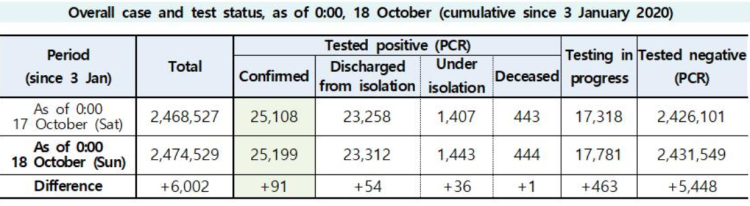 Overall case and test status for South Korea, 18 October 2020[/caption]
On their website (UPDATE 21 Nov 2020: these pages no longer available online), they point out the basis of their success, the three T's: Testing, Tracing, Treatment. The level of tracing conducted by South Korea would be horrifying for citizens of many other countries. In the beginning, in order to help people identify hotspots of infection, information -- gleaned from their cell phones detailing the pre-diagnosis daily activities of those who tested positive -- was published; even without naming them, they were easily identifiable. Some of these people experienced bullying after their identities were exposed. In order to alleviate this, online notification was restricted to two weeks and revealing data such as gender and age were no longer included. We can see how even a country experienced in dealing with epidemics can err under the cloud of urgency.
The government put out a 240-page booklet in English detailing South Korea's response to COVID-19. Notice the high degree of coordination among government and private agencies:
Overall case and test status for South Korea, 18 October 2020[/caption]
On their website (UPDATE 21 Nov 2020: these pages no longer available online), they point out the basis of their success, the three T's: Testing, Tracing, Treatment. The level of tracing conducted by South Korea would be horrifying for citizens of many other countries. In the beginning, in order to help people identify hotspots of infection, information -- gleaned from their cell phones detailing the pre-diagnosis daily activities of those who tested positive -- was published; even without naming them, they were easily identifiable. Some of these people experienced bullying after their identities were exposed. In order to alleviate this, online notification was restricted to two weeks and revealing data such as gender and age were no longer included. We can see how even a country experienced in dealing with epidemics can err under the cloud of urgency.
The government put out a 240-page booklet in English detailing South Korea's response to COVID-19. Notice the high degree of coordination among government and private agencies:
The Office for Government Policy Coordination, Ministry of Economy and Finance, Ministry of Education, Ministry of Science and ICT, Ministry of Foreign Affairs, Ministry of Justice, Ministry of the Interior and Safety, Ministry of Trade, Industry and Energy, Ministry of Health and Welfare, Korean National Police Agency, National Fire Agency, Korea Disease Control and Prevention Agency (formerly Korea Centers for Disease Control and Prevention), Korea Health Industry Development Institute, Korea Foundation for International Healthcare, Korea International Cooperation Agency, National Medical Center, Korea International Medical Association, Korea FoundationReligious or national holidays in which families gather are known to lead to increased spread of infection; in Israel, this led to the government imposing a lockdown that prevented people from celebrating outside of their nuclear family home. South Korea did not have to enforce a lockdown for the Chuseok mid-autumn festival; it was sufficient to encourage people to stay home because of their trust in the government:
It is a holiday deeply rooted in tradition. On the morning of Chuseok, children wear traditional bright, flowing silk hanbok garments and bow to their elders. Dishes of rice cakes, fruits, vegetables, fish and liquor are all laid across a table as offerings to the ancestors. For many married women, though, the tradition means not getting much of a holiday at all. They are expected to travel to their in-laws' celebrations — and spend the entire holiday cleaning and cooking. It's ... believed by some experts to be a factor in post-holiday spikes in divorce. But this year's Chuseok holiday ... marked a change from the past. Due to the coronavirus, the government discouraged travel and many families stayed put.In spite of all this, South Korea experienced a politicization of its pandemic fighting efforts just like many other countries. Most glaring was the Sarang Jeil Church that was behind the August spike in infections. The Church claims that the government is manipulating the statistics for political benefit. Members of the Church have held in-hall prayer meetings in spite of rulings banning them or severely restricting the number of participants and have accused the government of seeding the virus among its members. However, it was members of the Church who attended a large protest rally in August during which they infected other protesters. They also refuse to be tested and have foiled efforts at epidemiological tracing. The national government, Municipality of Seoul and the National Health Insurance Service are suing the Church for damages (about US$15 million) for expenses incurred as a result of the August outbreak of infections. In general, satisfaction with the government's handling of the crisis follows party lines, with those in favour of the ruling parties regarding their performance positively and those opposed having slightly more negative views. With time, however, the general sense is that the government is doing well, perhaps in view of "...international praise for their country’s response..." It is surprising, perhaps, given the positive impression other countries have of South Korea's policies regarding the pandemic, to find that 40% of those surveyed in Seoul report on increased mental health problems:
As for the reasons for the deterioration of mental health, the concerned respondents cited economic difficulties, economic downturn, lack of leisure life due to social distancing, reduced outdoor activities, reduced exchanges, inconvenience of wearing a mask, disconnection among family members and lack of interpersonal relationships.In spite of the fact that South Korea has far laxer policies than most other countries, 40% of the citizens report that they are having to cope with the same mental health issues as those experienced by places that have undergone lockdown and longer term social distancing measures. As South Korea eased social distancing to Level 1 this month, and children have been returning to school after a month of cancelled in-person classes, clusters of infection are still showing up. As spikes in infection continue to appear in various clusters around the country, they apply differential degrees of social distancing (there are three levels) according to specific need.
Japan
Japan experienced only 1661 deaths from COVID-19. And the country seems to be doing well in limiting the spread of the virus with a peak having been registered in July-August of over 1000 new cases daily. Since September, there are 300-600 new cases each day. Japan's success may be because:... the country has a culture of cleanliness, including washing hands frequently, and people bow in formal situations instead of shaking hands and do not kiss cheeks to greet friends or family. Similarly, wearing a mask in public is a habit that has been widely practiced for over a century and appears to have its roots in religious festivals.According to Makoto Iokibe, Chancellor of the University of Hyogo, the Japanese government did not take the virus seriously at first. They made two major errors in judgement: not gaining control over the Diamond Princess cruise ship in port and in letting Chinese tourists visit for their Spring Festival.
Junior high and high schools were closed on March 1, and the government asked people to avoid "enclosed spaces with little ventilation, crowded places with many people and close contact settings such as face-to-face conversations" and the people complied. Iokibe says the government based its approach:I think that what saved Japan from a dangerous situation was its distinguished infectious disease experts. From the end of January, the Ministry of Health, Labor and Welfare established a prevention headquarters that included experts in their fields. On Feb. 14, the government created its panel of experts that falls under the headquarters, and a plan to stop the virus based on their advice was drawn up.
On April 7, Prime Minister Shinzo Abe declared a state of emergency in 5 of the 47 prefectures and a week later this was extended to include the entire country. While not legally enforceable, the request was for schools, businesses and entertainment venues to close down and for people to work from home. With pachinko (gambling) parlours taking advantage of the lack of legal means to enforce their closure, the government decided to publish the names of those that have not complied in order to shame them into compliance. It has worked in some cases:... on requests to the populace, and in the name of the safety of society as a whole while being careful not to stop economic activity or excessively remove people's freedoms. It is a very lenient society that places its faith in high cultural standards.
On one hand, in a society where concepts of social obligation and good citizenship often exert as strong an influence on people’s behavior as the threat of fines or incarceration, the threat of being put on a list of shame for all to see could very well convince some pachinko parlors that it’s time to take a break until the health climate improves.However:
... making such information a matter of public record simultaneously creates a list of the remaining places where gamblers can still go to get their fix right now. Since some people have already shown they’re more worried about missing a jackpot than getting infected with the coronavirus ... [and] that could create even bigger crowds at those parlors which stubbornly choose to stay open, so in the end there really is no easy answer, except for people to take it upon themselves to stay home. [emphasis in the original]The state of emergency was lifted gradually, between May 14 and May 25, beginning with the least affected prefectures and and finally extending even to Tokyo and the surrounding areas. Each prefecture was given the right to independently determine how to handle the lifting of the state of emergency. A survey conducted on May 6 showed that most citizens agreed with the PM's intention to extend the state of emergency beyond its originally intended deadline with 66% saying this was the right thing to do and 25% saying the extension should be limited to particular regions. Interestingly, the survey showed that during the public holiday "Golden Week" (29 April - 5 May) only 1% of the population said they left home for leisure time activities or travel, the rest staying home or only going out to purchase essential items or to work. Given what we know about the pachinko parlours and about the role of shame in society, I wonder how many people were being truthful in their responses to this survey. In spite of the fact that there was no official lockdown, Japan has experienced the same economic woes that hit countries that did lock down. Both domestic spending and exports dramatically declined, leading to business failures and rising unemployment. A generous stimulus package was offered to businesses at risk; it was called a "cooperation grant" for cooperating with the request to close. An interesting initiative is a travel subsidy plan that began in July whereby the government covers 35% of the costs of an overnight stay in hotels and tour packages. His successor, PM Yoshihida Suga (from 16 September), is drawing up further economic recovery plans. The economic stresses are said to be behind many of the 13,000 suicides (including celebrity suicides), an upswing from previous years which had seen improvements as a result of vigourous efforts to reduce suicide in the country with the highest suicide rate. Sadly, youth and child suicide has also increased. This can be attributed to both bullying and academic pressures. After having had a break from school because of closures, some pupils were put back into bullying situations when they were mandated to return to the classroom. Others may have been overwhelmed with the pressure to catch up on material missed during school closure. About 15% of the schools in Japan report that some parents are keeping their children home to prevent infection. A medical institute survey reported that 72% of Japanese school children and adolescents feel stress over the COVID-19 pandemic.
The survey also found that 32 percent would not wish it to be known if they or their family members become infected with the virus, while 47 percent believe most people would wish to keep it a secret.
Twenty-two percent said they would not want to play or hang out with those who have contracted the virus, even once they recover.
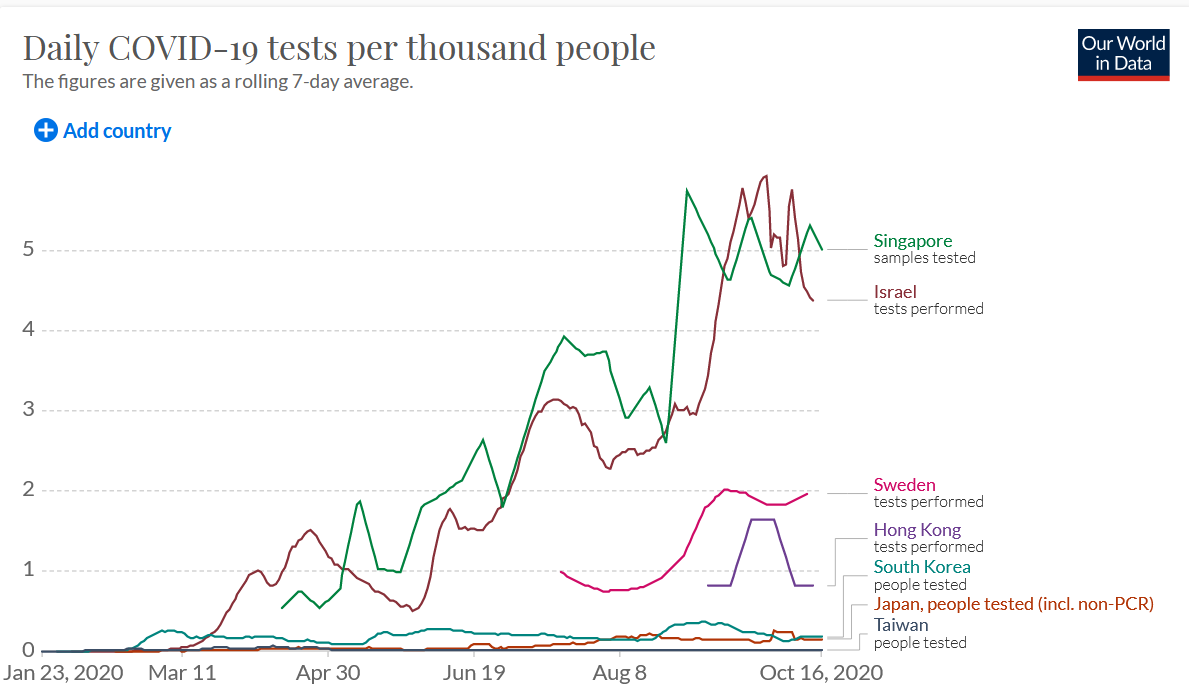
This shows the relevance of the element of shame, with some people blaming themselves for having become infected. This perhaps explains why Japan has been so successful in spite of the fact that their testing, that is touted as the best way to combat COVID-19, remains remarkably low, in contrast with the rest of the world:
Three of the motivating factors that induce Japanese nationals to adhere are courtesy, obligation and shame. Courtesy is the willingness to act out of genuine concern for others. Obligation involves placing the needs of the group before those of oneself. Shame is fear of what others might think if one does not comply to group or societal norms. There is no shortage of courtesy among the silent majority of the West, as unlikely as that can sometimes seem. A sense of obligation also exists, but typically toward groups less large than society as a whole. Shame, on the other hand, is not a dominant Western trait.Japan has decided that the point is to learn to live with COVID-19 and that:
... does not mean we must chase after it with blanket testing throughout society. Rather, our focus must be on implementing protective measures in daily life, preventing spread when contagion does occur, minimizing our individual risk of infection, getting tested immediately when we suspect we have been infected, and self-isolating or getting appropriate medical treatment as necessary. We need to also keep track of our own activities and movements so that our contacts can be traced and cluster-containment measures implemented if we do get infected. This is the essence of Japan’s strategies for living with COVID-19 rather than trying to eradicate it, and this explains why Japan has been able to limit its number of cases and deaths even with little testing or stringent implementing of [legally enforced] social distancing measures.
Discussion (0)
No comments yet. Be the first to share your thoughts!
You must be logged in to join the discussion.
Log in here or create an account.